Reading Meeting Minutes Without Mistaking Them for a Transcript
Reading meeting minutes carefully helps you identify decisions, recorded actions and omissions without treating a concise formal record as a full transcript.

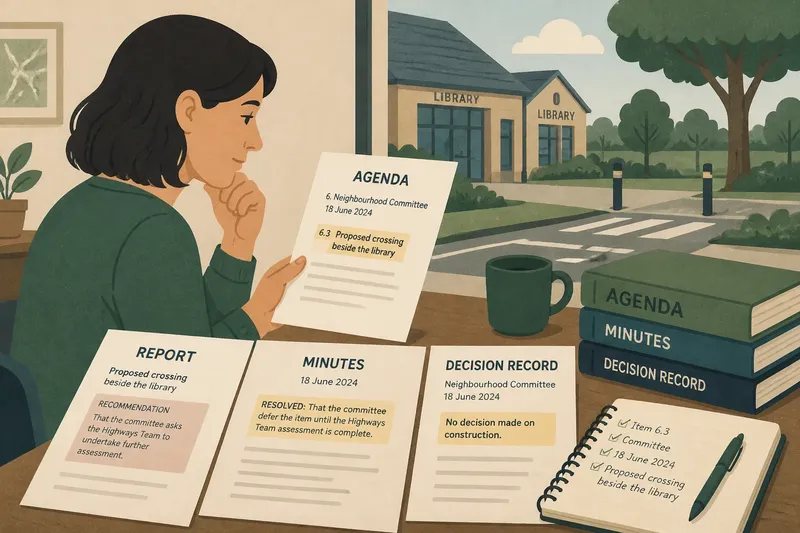
You open the council meeting minutes looking for what happened to a proposed crossing, and find a few lines where you expected a conversation. Reading meeting minutes means treating those lines as a selected formal record: they show the business handled and the outcomes recorded, not every comment made in the room.
What do meeting minutes record?
Minutes document a meeting’s official business in a form that can be checked later. Depending on the body’s rules and the kind of meeting, they may record attendance, agenda items, motions, decisions, votes, assigned actions and the time the meeting ended.
They are selective by design. A minute-taker captures information needed to establish what the group considered and did; they do not normally reproduce every question, argument or change of tone. Think of minutes as a labelled jar: they preserve the essential contents, not every movement that happened while it was being filled.
The amount of detail varies. One committee may record a motion and its outcome, while another also summarises the main points raised. That difference does not, by itself, mean one set is more accurate. The relevant standard is the organisation’s own procedure and the record’s stated purpose.
Why do minutes leave out things people said?
Because a record of business is not necessarily a record of speech. A long discussion may lead to one proposal, a revised motion and a decision; minutes may preserve those formal stages without summarising each speaker’s contribution.
This selectivity can make the document feel incomplete if you are trying to reconstruct why someone changed their mind or how the room responded. It may also reflect the minute-taker’s remit: they are expected to capture the meeting’s official proceedings, not create a narrative of every exchange.
Silence in the minutes does not establish that a point was never raised. It only tells you that the point is not included in that document. Avoid attributing a view to a person unless the record identifies them and clearly states what they said or proposed.
How can I tell a decision from discussion?
Look for the language that marks a formal action. Words such as “resolved”, “approved”, “deferred” or “noted” can signal what the group did, though their meaning depends on the organisation’s rules and the surrounding text.
A discussion summary describes subjects or arguments; a decision records an outcome. “Members discussed options for the crossing” does not say which option was chosen. “The committee resolved to request a revised crossing plan” records an action, but it does not tell you that the plan was built or approved by another authority.
Check whether a motion is stated, whether it was carried, amended or rejected, and whether any follow-up is assigned. If minutes say only that an item was “considered”, do not read that as approval. A proposal can be heard without being adopted.
What can a vote tell me?
A recorded vote can show how members formally voted on a motion, but it may not explain their reasons. The minutes might give the outcome alone, list votes by name, or record that the decision was unanimous; each format offers a different level of detail.
Do not infer support for a whole project from a vote on one specific motion. A group might vote to ask for more information, for example, without deciding whether to proceed with the project. Read the motion itself before interpreting the result.
Where the record says a motion “carried”, that generally indicates it passed under the meeting’s procedure. If the outcome matters to a dispute, formal submission or legal question, consult the organisation’s rules or seek qualified advice rather than relying on an informal reading.
What details should I check before drawing a conclusion?
Start with the meeting date, body name and document status. Draft minutes may still be awaiting approval, while an approved version may contain corrections; check any heading, footnote or later record that identifies the version.
- Agenda item: Confirm the decision belongs to the subject you are investigating.
- Motion wording: Read the exact proposal, including amendments, rather than relying on a short heading.
- Outcome: Distinguish approval from rejection, deferral, referral or discussion without a decision.
- Action: Note who is asked to do what, and whether the record gives a later reporting point.
- Attendance and voting: Check what is recorded before assuming who was present or how each person voted.
- Approval status: See whether the minutes are draft, confirmed or corrected.
These checks help you make a precise claim. “The committee asked officers to bring back options” is narrower and more useful than “the committee approved the scheme” if the recorded action was only to request further work.
What should I read if I need the full discussion?
Minutes may not answer questions about the wording of a speaker’s comment, the order of arguments or the reason behind a vote. Depending on the meeting, other sources could include an audio or video recording, a webcast, a separate decision record, a report considered by members or a written submission.
First check whether another record exists and what it covers. A recording may include discussion but not private or confidential business, and a decision notice may explain the outcome without preserving the conversation. Ask the relevant clerk or public information contact where meeting records are kept; the body’s publication practices and access rules can differ.
Say you are checking whether a parks committee approved a new gate. The minutes state that members discussed access and resolved to ask staff for a revised plan. You can accurately report that further work was requested, then look for a later meeting record before claiming the gate was approved.
Can minutes be corrected after a meeting?
Yes, a draft may be corrected or confirmed at a later meeting under the body’s procedures. Corrections usually address the accuracy of the record, such as a name, date or decision wording; they are not necessarily a chance to add a full account of discussion that was never recorded.
If a point appears wrong, identify the meeting and the precise passage, then ask the clerk how corrections are considered. For an important claim, keep track of whether you are reading a draft or an approved version.
How should I describe what the minutes say?
Use language that matches the level of evidence in the record. “The minutes record that the motion passed” is safer than “everyone agreed”, unless the record expressly supports that stronger statement.
Separate the recorded event from your interpretation: say what the group decided, then identify any uncertainty about reasons or consequences. Reading meeting minutes this way lets you use them as a dependable account of formal business without asking them to serve as a transcript they were never intended to be.