How Public Noticeboards Became Part of Shared Places
Public noticeboards give local information a visible home. See how their setting, layout and upkeep affect what neighbours notice and how they use it.
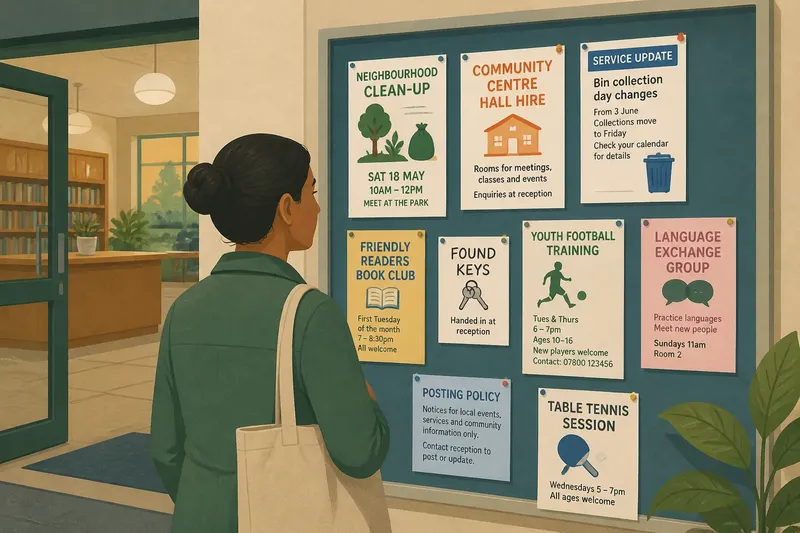
You pause by a library entrance to check the opening hours and spot a sheet about a neighbourhood clean-up. Public noticeboards have become familiar because they give local information a visible home in places people already visit.
Their familiarity is practical rather than mysterious. Shared buildings have doors, foyers and waiting areas where people naturally stop; a board placed there can bring event details, service updates and community requests together. Its usefulness depends on where it sits, what it displays and how clearly people can tell who is responsible for the notices.
Shared buildings give local notices a natural home
Libraries, community halls, housing foyers and laundrettes serve different purposes, but each can bring neighbours into the same space. A noticeboard turns part of that space into a place for passing on information. It does not require visitors to seek out a separate publication or website before they can encounter a local message.
The setting also shapes the likely audience. A board near a community centre entrance may reach people attending different activities, while one inside a sports pavilion may mostly reach players and families. Neither location represents everyone nearby; each offers a particular route to local attention.
Placement matters. A panel behind an open door, high above a seated visitor or crowded by other signs may be difficult to notice. Like a label on a cupboard, a noticeboard helps only when it can be seen from where people need to use it.
Repeated use makes the board recognisable
A board becomes familiar when people encounter it as part of a recurring visit: checking in at a reception desk, waiting for an appointment or walking through a hall. Seeing the same display in a recognisable place can make it easier to remember where local information might be posted. That does not mean every passer-by reads it or that every message reaches its intended audience.
The variety of notices can reinforce this role. A board might bring together a club meeting, a change to a local service, an event invitation and information about a found item. Their common feature is local relevance, not a shared author or official status.
A public location does not confirm that a message is accurate or current. Look for the organisation’s name, contact route, intended audience and date. If key details are missing, ask the venue or the named organisation rather than treating the board itself as confirmation.
Layout and upkeep affect what visitors can read
The largest sheet or clearest heading may catch the eye first, while a small handbill tucked beneath other pages can be missed. Overlapping notices can hide dates and contact details, making it harder to judge whether information still applies. A clear arrangement with space between sheets helps visitors scan without having to disentangle the display.
Physical access matters as well. Glare on a cover, cramped handwriting or a panel in a narrow corridor can make reading or stopping uncomfortable. These details affect who can use the information, not just how tidy the board looks.
Upkeep can make the display easier to understand, but neatness cannot certify each notice. A named host or posting policy can tell visitors whom to contact about an outdated sheet, a damaged panel or permission to add information. If no contact is shown, asking staff where appropriate is better than assuming the board is open for anyone to post.
What should you check before relying on a notice?
Who is the notice for?
Check whether it names a neighbourhood, group, service or eligibility condition. If the audience is unclear, ask the named organisation whether the information applies to you.
When does the information apply?
Look for a posting date, event time or deadline, and check whether any details are obscured. If the timing is missing or unclear, confirm it with the organisation or venue before making plans.
Who produced the message?
A group name, office or contact route helps identify the source. If there is no clear source, treat the notice as unverified and seek confirmation elsewhere.
How can someone add or correct information?
Look for a posting policy, named contact or place to leave material. If none appears, ask the host how to submit a notice rather than attaching it without permission.
A worked example shows how to check a change
Imagine you arrive at a community centre for a weekly language group and see a handwritten note saying the room has changed. The note names the group but has no date, and the new room is not stated clearly. You ask reception whether the change applies to that evening; staff confirm the room number, so you can go to the right place without relying on an undated message.
That simple check separates what the notice says from what you need to know. For a change that affects an appointment, service or other important arrangement, use the contact details on the notice or ask the responsible organisation for confirmation.
A board reaches some neighbours, not everyone
A noticeboard reaches people who pass through its location. Someone who does not visit the building, cannot comfortably approach the panel or finds the text difficult to read may not encounter its messages. A board is therefore one local information channel, not a complete way to communicate with a whole community.
It can still reveal information that a visitor was not seeking. Browsing several notices together is like looking along a shelf of mixed leaflets: an event may catch your eye while you are checking something else. That chance encounter is useful, but it does not tell you whether details have since changed.
Public noticeboards remain familiar because shared places give local information a recognisable address. When using one, check both the message and its source, and remember that the board’s position determines which neighbours are most likely to see it.