A First Visit to a Public Meeting: What to Notice in the Room
A first visit to a public meeting is easier when you know where to sit, how to follow the agenda and which access options can help you take part.
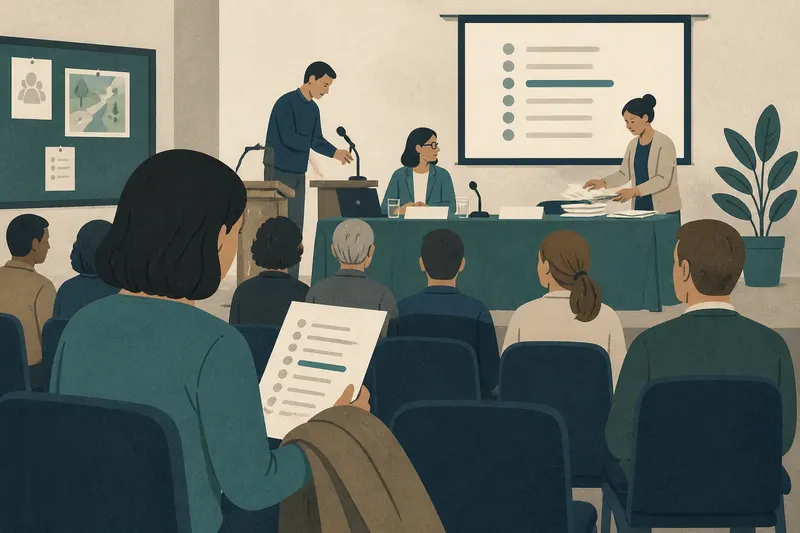
You arrive at a public meeting with a folded agenda in one hand and a coat over your arm. At the entrance, people are choosing seats, a speaker is checking a microphone and a staff member is arranging papers. A first visit to a public meeting is easier when you know what to notice in the room and how to follow the arrangements without guessing at people’s formal roles.
Use the room layout to find your bearings
Look for the main table, a chair or desk at the front, and any screen or noticeboard displaying the agenda. These features can show where the meeting is being led and where speakers may address the room, but the layout alone does not establish who has authority or what each person’s role is.
Choose a seat with a clear view of faces and shared displays. If hearing is a concern, ask whether microphones or a hearing assistance system are available. An aisle seat can make it easier to leave quietly, while a seat closer to the speakers may help in a large or echoing room.
Some meetings use rows facing a panel; others place participants around tables. In rows, the front is the obvious visual focus. Around tables, speakers may be in different directions, so follow whoever is speaking rather than assuming the person nearest the front is leading every exchange.
The agenda is a little like a bus route: it shows the intended stops, but the order may change. Keep it handy and note the current item instead of relying on a printed sequence to predict exactly when a subject will come up.
Follow the agenda without trying to record everything
Agendas often group business into opening formalities, reports, public contributions, discussion and decisions. Labels and order vary between organisations. An item marked for information may invite questions without asking the group to decide anything; an item marked for decision is more likely to involve a formal choice.
Listen for the chair or meeting lead to name an item, introduce a report or invite contributions. Your purpose on a first visit is to understand the meeting’s rhythm: when people are presenting information, when they are exchanging views and when the group moves to its next task. You do not need to reconstruct the formal outcome from each exchange.
Items may be postponed, combined or taken out of order. If the conversation no longer matches your agenda page, check a screen for an updated order or ask a steward during a pause. The meeting may simply have moved to another item.
Say you attend an invented neighbourhood committee meeting because a footpath is on the agenda. You bring the printed agenda, mark the footpath item, and note when the chair moves from a report to questions and then to a proposal. The result is a short map of how the item unfolded; if the order changes, you can add the new sequence rather than assuming the agenda was wrong.
Choose a way to follow that suits you
Some visitors prefer to listen with the agenda in hand; others make brief notes or use access arrangements. Choose the approach that lets you attend to the meeting rather than turning a first visit into a transcription exercise.
- Agenda in hand: Check whether the current item matches the printed order. If it does, mark the heading and listen; if it does not, check a display or ask a steward whether the order has changed.
- Brief notes: Check whether you need to remember a particular issue or follow-up. If you do, jot down the agenda item and a few keywords; if not, leave the notebook closed and listen.
- Accessible seating: Check whether you can see and hear from the available seats. If not, ask the steward about a suitable place; if the room cannot meet your needs, contact the organiser about another arrangement.
- Hearing assistance: Check whether the venue has a hearing loop or another system and how to use it. If one is available, ask for instructions; if it is not, ask about a seat near a microphone or another option.
- Captions or remote access: Check the meeting notice for captions, a live stream or a remote participation link. If the listed option suits your needs, follow its joining instructions; if none is listed, ask the organiser what alternatives are available.
- Speaking during the meeting: Check the agenda and notice for a public contribution slot and any registration rules. If the process is clear, follow it; if it is not, contact the organiser before the meeting instead of interrupting an active discussion.
Short notes can keep the experience manageable. Write down the item you are following and any question you want to remember; leave detailed accounts of formal decisions to the published record and the meeting’s own procedures.
Notice roles without guessing from where people sit
A chair may introduce speakers, manage turns and explain the task before the group. A clerk, secretary or other staff member may support the meeting or answer procedural questions. Those functions do not, by themselves, tell you whether someone is a voting member.
Nameplates and introductions can help you follow who is speaking, but seating is not proof of formal status. If knowing a person’s role matters to you, check the meeting’s published information or ask the organiser during a suitable pause.
Public contributions may be handled in a dedicated agenda slot, through written submissions or under rules set by the organising body. Attending does not necessarily mean visitors can speak at any point. Check the notice for timing and registration, then follow the chair’s directions.
What should you check before your first visit?
Can I speak during the meeting?
Look for a public-comment or deputation item in the agenda, then check whether the notice explains how to take part. If the arrangements are unclear, contact the organiser before the meeting rather than interrupting a discussion.
What if I arrive after the meeting starts?
Enter quietly and take an available seat without crossing in front of a speaker if you can. Use the agenda or a pause to identify the current item; a steward may be able to point you to the right place.
How can I follow the meeting if I cannot hear or see well?
Ask the organiser about suitable seating, microphones, hearing assistance, captions or remote access. If the notice does not describe an option that meets your needs, ask what alternative arrangements may be possible.
Where can I check the meeting’s arrangements?
Start with the meeting notice and agenda, which may explain access, public contributions and any changes to the schedule. If a practical detail is missing, contact the organiser before attending rather than relying on assumptions about local practice.
Make the visit useful by focusing on the room
If your aim is to understand how the meeting proceeds, sit where you can see the chair and any shared display, then follow the agenda headings. If you want to keep track of one subject, mark it on the agenda and make brief notes. If access is your priority, ask about arrangements before choosing a seat or deciding whether to attend in person.
Local procedures and access options differ, so follow the meeting notice and the organiser’s instructions. A first visit to a public meeting need not leave you with a record of every exchange: it can help you learn where to sit, how the room is organised and which practical questions to ask before the next visit.