How to Read a Council Agenda, Minutes and Decision Record
Learn how to read a council agenda, minutes and decision record to trace a proposal, identify its current status and avoid mistaking advice for approval.
A council agenda lists a footpath repair for discussion, but the attached report recommends only that officers inspect the site. To learn whether the repair was approved, you need to trace the item beyond the agenda. Knowing how to read a council agenda, minutes and decision record helps you follow a proposal through its different stages.
Use each paper to answer a different question
These documents are not simply three accounts of the same meeting. An agenda sets out planned business, supporting reports explain the options, minutes record proceedings, and a decision record may identify a formal outcome. The names and publication practices vary between councils, so check what each document actually contains.
Start by choosing the question you need answered: Was the matter scheduled? What action did the meeting record? Which body or officer made a decision? What happened afterwards? A single file may answer one of these questions without addressing the rest.
Think of the documents like a route map and a travel log. The agenda shows the intended route; it cannot tell you whether the journey went ahead or changed direction.
An agenda identifies the proposal and its supporting papers
Find the meeting date, committee name, item number and exact title. Then open the report attached to the item. A heading such as “footpath repairs” may be brief, while the report explains the location, options and any officer recommendation.
Keep a recommendation separate from an outcome. If a report advises members to approve work, that is advice for consideration, not evidence that approval followed. The agenda also cannot show whether an item was postponed, amended or not reached.
Record a distinctive phrase from the title and the item number before moving on. Those details can help match the proposal to later papers, especially if related matters appear before more than one committee.
Minutes trace what the meeting formally recorded
Minutes are generally a record of proceedings, not a word-for-word account of everything said. Their detail varies. An entry may give the resolution and follow-up action without reproducing the debate, so a short account does not by itself mean the item was ignored.
Read the complete entry and pay attention to verbs. “Approved” indicates a different outcome from “deferred”, “referred” or “noted”; “recommended” may mean that another body must decide. Also check for conditions, deadlines or instructions about what happens next.
Look at the document’s status and date. A draft may later be corrected or confirmed, while a later meeting may revisit the same proposal. When tracing an outcome, distinguish a new decision from a correction to an earlier record.
A decision record may name the decision-maker and outcome
Councils use different names for records of decisions. One council may publish a decision notice, another may place the resolution in its minutes, and a delegated officer’s decision may appear in a separate entry. Do not assume that a file called “decision record” is the only authoritative source.
Check who made the decision, when it was made, what matter it covers and the exact outcome. An officer’s record may concern a delegated power; a committee resolution may require further action by another body. A later implementation update tells you what was done, but should not be confused with the original decision.
If the legal effect of a decision matters to you, consult the council’s published procedures or contact its records team. For an everyday question, matching the item, decision-maker and wording across the papers can usually clarify what the record says.
Which council document should you check first?
Where can I find what the council planned to discuss?
Open the agenda and the report linked to the item. Together, they show the scheduled subject and the background or recommendation presented for consideration.
How can I tell whether a recommendation became a decision?
Look for the later minutes or a decision entry that states what the relevant body or officer resolved. A recommendation alone does not show that it was accepted.
What should I do if a later paper changes the outcome?
Compare the meeting dates and read each entry for references to deferral, referral or reconsideration. A later decision may replace an earlier position, but its wording should identify what changed.
Which record should I rely on if the papers conflict?
Check whether one file is a draft, a later correction or a record of a subsequent decision. If the difference remains unclear, ask the council which document records the formal outcome.
Trace one item from proposal to outcome
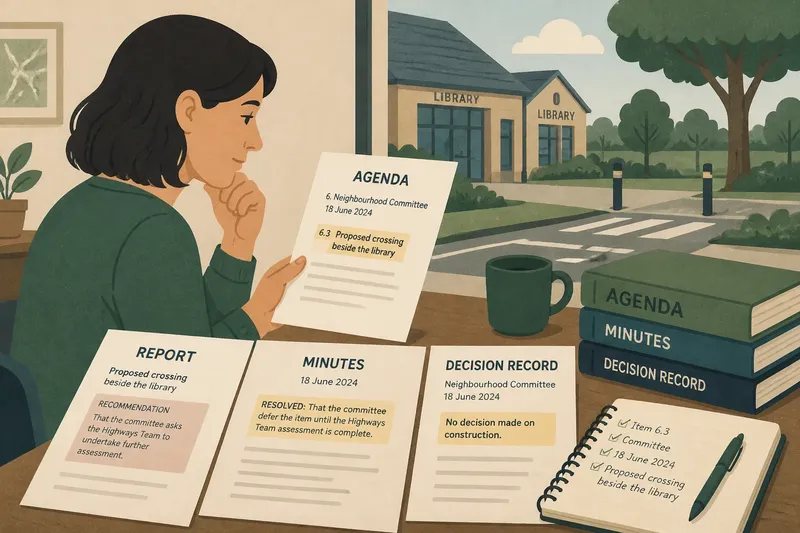
Imagine a neighbourhood committee agenda lists a proposed crossing beside a library. Its report recommends asking the highways team for further assessment. The minutes then record that the committee deferred the item until that assessment is complete, and the decision page contains no approval for construction.
In this invented situation, the available record supports a narrow conclusion: the proposal was considered and deferred, not approved for construction. The agenda identifies the subject, the report provides advice, and the minutes state the recorded action. The missing approval entry does not turn the recommendation into a decision.
To check what happens next, search the council site using the committee name, meeting date and agenda item title. If a later paper refers to the assessment, compare its resolution with the earlier minutes before describing the proposal’s status.
Match your wording to the record
When sharing what you have found, describe only what the document supports. An agenda supports “the committee was due to consider the proposal”; a report may support “officers recommended further assessment”; and a resolution may support “the committee deferred the item”. Those statements keep advice, planned business and recorded action distinct.
For a council agenda, minutes and decision record, the useful habit is to follow the item rather than trust a file name. Carry its title and date across the papers, check who acted, and let the recorded wording determine what you say happened.